By Teresa Murray for Backline Live
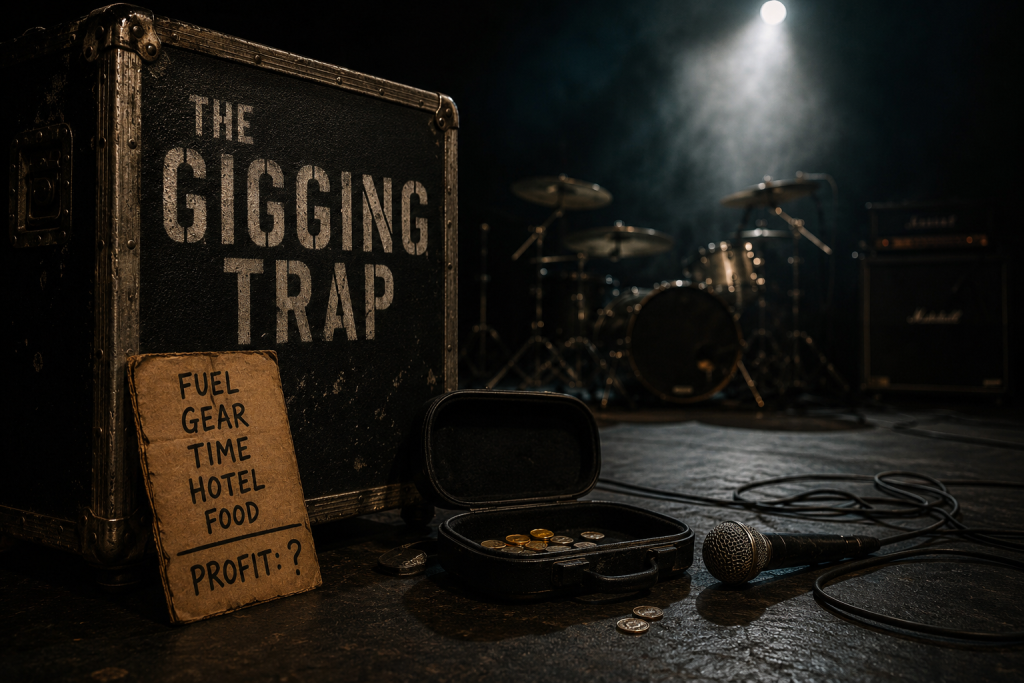
(AI Generated Image)
Musicians need gigs to get known — but often need to be known to get gigs.
Being a musician is one of the most rewarding things a person can do.
It is also, for many people, one of the least supported.
There is nothing quite like playing music, writing music, being in a band, building a sound with other people, or standing on a stage and feeling something move through a room. That is why so many musicians persist despite the barriers, costs, awkward logistics, unstable line-ups, limited opportunities and very uncertain rewards.
Over the past few months, I have been speaking with musicians at different stages — solo artists, bands, new acts, experienced players — and the same challenges keep coming up.
Again and again, the biggest one is this:
Musicians need gigs to get known, but often need to be known to get gigs.
That is the trap.
The Visibility Problem
How do you get booked when most of your online following is made up of friends, partners, cousins, work colleagues, supportive aunts and three people from school who still like everything you post?
How do you convince a venue, booker or promoter that you can draw a crowd when you have not yet had enough opportunities to build one?
How do you play enough gigs to develop your audience when so many early opportunities are unpaid, low-paid or framed as “exposure”?
And how do you keep doing that when music already costs money before it ever makes money?
Why Gigging Still Matters
Before we go any further, it is worth asking a more basic question.
Why gig at all?
Some people might say gigging is less important now. Everything is digital. You can record at home. You can release online. You can build a following through social media.
All of that is true.
But it is not the whole truth.
Playing live teaches things that practice cannot.
It teaches musicians to listen, adjust, recover, manage nerves, read a room, hold attention, and understand what actually connects with people. It is not the same as playing alone at home. It is not the same as recording into a DAW. It is not the same as rehearsing in a room where everyone gets to stop and start again.
On stage, the song has to keep moving.
A musician can be brilliant at home, playing along to tracks, recording parts, building layers, fixing mistakes and polishing takes. But put that same musician on stage with no backing track, three other humans, a noisy room and a crowd in front of them, and a different set of skills is required.
Live playing forces musicians to hear each other.
It forces timing. It forces recovery. It forces communication. It forces restraint. It forces the band to become a band, not just a group of people playing at the same time.
It also gives musicians direct feedback from the audience.
Not abstract data. Not likes. Not views. Not the strange little numbers social media throws around like confetti from a broken machine.
Actual feedback.
What songs make people move? What lines land? What moments pull people in? What falls flat? What gets remembered? What makes someone come up afterwards and ask where they can hear more?
That matters.
Live gigs can also become one of the most effective routes into digital growth. Someone hears you in a room, feels something, follows you afterwards, shares a clip, brings a friend next time, looks up your music, joins the small but precious group of people who actually care what you do next.
That is very different from shouting into the endless digital fog and hoping the algorithm coughs politely in your direction.
And then there is nerve management.
Gigging gives you that for free, whether you wanted the lesson or not.
The Economics of Gigging
But the problem remains: live opportunities are not evenly available.
That does not mean everyone involved in booking is a villain sitting in a dark room stroking a cat and refusing to answer emails. Venues have pressures. Promoters have pressures. Pubs have to protect their margins. Bookers have to think about crowds, bar sales, reputation, reliability and risk.
They cannot give every stage to every person who wants one.
That is understandable.
But it still creates a real problem for musicians trying to build something.
Early gigs can be hard to get. Paid gigs can be harder again. Travel costs money. Rehearsals take time. Petrol is not getting cheaper. Gear has to be bought, maintained, carried, set up, broken down, fixed, replaced and occasionally sworn at in a car park.
And when a band does get paid, that money often has to be split between several people. By the time transport, rehearsal time, food, strings, sticks, cables, fuel and general chaos are accounted for, the financial reward can be very thin.
For established acts, this may be less of an issue. For musicians starting out, returning, rebuilding, or trying to gain a foothold in the scene, it is very much an issue.
Keeping a Band Together
Then there is the band problem.
Keeping a solid line-up together is one of the great invisible challenges of live music.
People outside bands may not realise how fragile a band can be. One member leaving can change everything. A singer leaves. A drummer moves away. A guitarist’s work hours change. A bassist has family commitments. Two members want heavier material, one wants more melody, someone else has had enough of the WhatsApp group and would like to be released back into the wild.
There are endless reasons bands lose members: musical direction, personality clashes, work, family, money, transport, confidence, health, time, motivation, life.
For cover bands or tribute acts, a line-up change can still be difficult, but the material is at least known. A new member may already know some of the songs or be able to learn them quickly.
For original bands, the problem is often bigger.
Originals, covers and the missing outlet
Original music has its own internal language. The songs may not be recorded properly yet. Parts may have developed through months of rehearsal. Arrangements may live in the collective memory of the band rather than neatly written down. A new vocalist, drummer, guitarist or bassist has to learn not just the notes, but the feel, structure, intention and chemistry of the songs.
That takes time.
And while that is happening, what does the band do?
Gig without the missing piece? Stop gigging? Rewrite? Rehearse for months? Lose momentum? Start again?
This is one reason musician turnover can quietly destroy progress. Not dramatically. Not with a grand explosion. More like a slow puncture.
Then there is the question of originals versus covers.
Covers are useful. They teach timing, arrangement, performance, structure, audience awareness and discipline. They can make musicians tighter. They can help a band learn how to play together. They can get people dancing, singing, listening and staying in the room.
There is nothing wrong with covers.
But many musicians do not want to spend their whole creative life only playing songs other people have already written.
For many, writing original music is the natural next step.
And songwriting is not just one person sitting moodily with a guitar and a notebook, though there is room for that too if the lighting is right.
Songwriting can be collaborative. A guitarist brings a riff. A drummer changes the feel. A bassist finds movement between the chords. A vocalist discovers what can actually be sung. A lyric appears. A chorus shifts. A bridge gets murdered. A song becomes something none of the members would have written alone.
That process matters.
Many musicians have original material stored everywhere: riffs on phones, lyrics in notebooks, melodies in voice notes, unfinished demos, rehearsal room recordings, fragments waiting for a band, a gig, a reason.
But what happens to all that music if there is no outlet for it?
If venues mostly want recognisable songs, and audiences mostly respond to songs they already know, original artists face another loop.
How can audiences recognise a band’s original music if they never get to hear it?
Recording is one option, but recording takes time, money and skill. Doing it yourself means learning software, interfaces, microphones, mixing, editing and the dark psychological arts of “why does this sound terrible in the car?” Outsourcing it costs money many musicians do not have.
Either way, there is no guaranteed return.
The cost of gear
And then there is gear.
You do not need a €5,000 guitar to be a good musician. You do not need the most expensive drum kit in the country. We all know that.
But the “you don’t need fancy gear” argument can sometimes hide the fact that you do still need gear.
You need instruments that stay in tune. Amps that work. Cables that do not betray you. Microphones. Stands. Pedals. Strings. Sticks. Cases. Interfaces. Mixers. Monitors. A PA, depending on the situation. Transport. Storage. Repairs. Replacements. The mysterious emergency cable that nobody can find even though there were seven of them yesterday.
And if you want to record, film, promote or release your music, the list grows again.
None of this makes music impossible.
It just makes it harder than people often realise.
Why musicians keep going
And yet, despite all of this, thousands of people keep doing it.
They play. They write. They rehearse. They record. They carry amps up stairs. They drive to gigs that barely cover petrol. They rebuild after line-up changes. They post into the void. They learn new songs. They write new songs. They try again.
Not because it is easy.
Not because most of them expect to become rich, famous or even widely seen.
They do it because the doing of it is the magical thing.
But hell.
It could be a bit easier though, couldn’t it?