by Teresa Murray for Backline Live
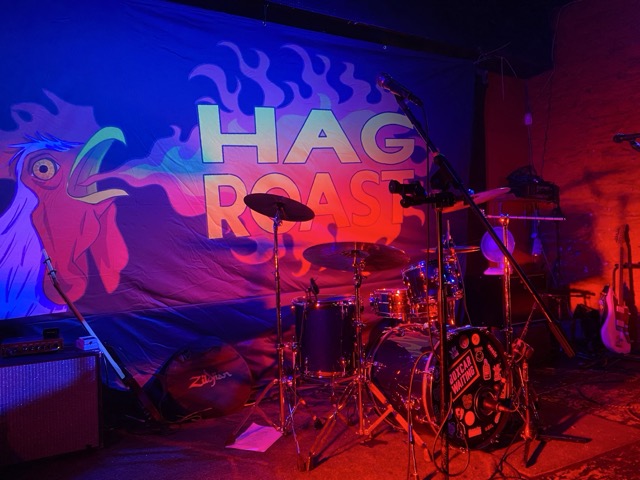
I went to see Hag Roast in Fred Zeppelin’s last week.
Hag Roast are a local Cork band who play their own original music alongside covers of Alice in Chains. That alone caught my attention, because Alice in Chains are not an easy band to cover.
Not instrumentally.
And certainly not vocally.
There are some bands where the songs are more than the chords, riffs and lyrics. Alice in Chains are one of those bands. Their music has a weight to it. The songs are heavy, yes, but not only in the obvious way. They carry tension, atmosphere, melody, discomfort, beauty, restraint and force all at once.
That is hard to reproduce without flattening it.
A band can technically play the right notes and still miss the point entirely.
Hag Roast did not miss the point.
In my view, they nailed it.
What impressed me most was not simply that they could play the songs. It was how they played as a unit. The songs held together. The feel was there. The band understood that this music is not about showing off. It is about serving the atmosphere, the vocal, the groove, the heaviness and the space between all of those things.
The two guitarists, Tristan Tait and Dave Cowhey, were tight, clear and controlled, with neither crowding the other or drowning out the band. That matters with music this dense. Alice in Chains songs need weight and atmosphere, but if the guitars turn into a wall of mush, the detail disappears. Hag Roast avoided that.
The rhythm parts had the heaviness the songs needed, while the lead lines cut through with real skill and purpose. Nothing felt showy for the sake of it. The guitar work served the songs.
The bass played by Greg Hayes, had real presence too. It gave the songs depth and movement without taking over, with enough feel and dynamics in the low end to help the whole band hold its shape.
And then there was the vocalist, Elliot Doran.
Covering Layne Staley is brave territory. Let’s just say that.
Staley was one of the great rock vocalists. His voice could sound wounded, furious, exposed, powerful and almost otherworldly, sometimes within the same line. His performance of “Love, Hate, Love” from Alice in Chains’ Live at the Moore show in Seattle in 1990 remains, for me, one of the great live rock vocal performances.
It is not the kind of thing many singers should attempt casually in some Open Mic scenario.
But Hag Roast’s vocalist, Elliot Doran brought real power to the material. Not imitation. Not costume. Not karaoke theatre. A performance, and they owned it.
The best covers do not simply copy the original. They respect it. They understand what has to be carried across and what has to be allowed to live differently in the room.
Alice in Chains, of course, were never only Layne Staley.
Because of the intensity of Staley’s voice, and because so much attention has been placed on his addiction and death, the musical architecture of the band can sometimes get overshadowed. That is a pity, because Alice in Chains were an extraordinary band, not just an extraordinary singer.
Jerry Cantrell’s songwriting deserves more attention than it often gets.
He is recognised, of course. Nobody seriously interested in rock music is going to pretend Cantrell was a passenger. But still, there is something understated about how his contribution is discussed. He was not simply the guitarist. He was a central architect of the Alice in Chains sound.
Before he became known as a songwriter, Cantrell has described himself as a collector of riffs. You can hear that in the early material. Facelift, their debut album, is not a tentative first step. It is already full of identity. Song after song has shape, hooks, weight and purpose.
The riffs are heavy, but rarely just heavy for the sake of it. There is melody inside the darkness. The guitar parts often feel like they are pulling against the vocal rather than simply sitting underneath it. The songs do not just move from section to section. They drag you through a mood.
That is craft.
Cantrell’s guitar playing is not all speed and display. It is more dangerous than that. It is taste, tone, timing, riff, melody, harmony and restraint. He knows how to make a guitar part feel inevitable.
The 1996 MTV Unplugged performance makes that especially clear. Stripped back, songs like “Nutshell,” “Rooster” and “Down in a Hole” do not become smaller. If anything, they become heavier.
Without the full force of distortion around them, the songwriting has nowhere to hide — and it does not need to. The melodies, harmonies and lyrics hold their own completely.
Those performances show that Alice in Chains were never just a heavy band. They were a great songwriting band.
That combination of heaviness and emotional clarity is one reason the music still lands.
I am always interested in where great musicians come from, not just where they end up. Cantrell’s story is not one of neat privilege and an easy road into music. He came from a difficult background, but there is a clear sense, even in the early history of Alice in Chains, of someone driven and deliberate. He knew what he wanted to build before he had all the proof that it could work.
With Sean Kinney on drums, Layne Staley on vocals and Mike Starr on bass, Alice in Chains became something unusually distinctive very quickly.
And speaking of Sean Kinney: he may be one of the most underrated drummers in rock.
When people talk about great rock drummers, the same names come up again and again. John Bonham. Neil Peart. Mike Portnoy. Matt Cameron. Dave Grohl. Stewart Copeland. Danny Carey. All fair names.
But Sean Kinney is often missing from those conversations.
He should not be.
Kinney’s playing has feel. Groove. Space. Weight. He is not a drummer who sounds like he is trying to win an argument with the rest of the band. He serves the songs, and that is exactly why the parts work. Imagine Alice in Chains without those drum patterns, without that sense of pull, without that heavy but human movement underneath the guitars and vocals.
It would not be the same band.
That is the thing about great drummers. Sometimes people only notice them when they are loud, fast or spectacular. But song drumming is its own art. Holding the shape of a song, creating tension, sitting in the pocket, knowing when not to fill every gap — that is musicianship.
Hag Roast’s drummer understood that.
There is no better tribute to a great original part than respecting its essence. Not copying every breath mechanically, but carrying the feel of it honestly.
That is what Hag Roast did well in Fred Zeppelin’s. They did not treat Alice in Chains as a costume. They treated the songs as songs. Heavy songs, difficult songs, emotionally loaded songs — but songs first.
I was standing beside a man I did not know from Adam who had never seen Hag Roast before. He told me he had seen Layne Staley live, and he was visibly impressed by Hag Roast’s vocalist and the whole band. He kept coming back to it. The power, the control, the fact that the vocalist could carry that material and carry it so well.
That says something.
Because when someone has seen the original and still respects the cover, the band has done more than get through the set.
They have honoured the music.
And that, to me, is what made the Hag Roast gig worth writing about.
It was not just a local band playing songs by a famous band. It was a reminder of how demanding great rock music can be, how much musicianship sits beneath the surface, and how powerful it is when a local band takes on difficult material and does it justice.
Alice in Chains wrote songs with weight.
Hag Roast carried that weight well.