Why Every Intermediate Guitar Player Should Spend Six Months Playing Bass
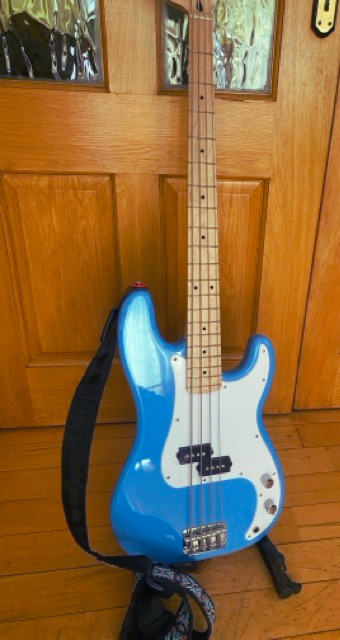
I had never paid any attention to the bass guitar until about a year ago. Then I came across a YouTuber, BassBuzz, who made funny instructional videos about playing bass. At first I watched for the humour, but curiosity crept in and, a few months later, I bought my first bass guitar. The justification I used for the outlay was that it might improve my drumming, which I had recently started and loved.
It was literally love at first play.
I started learning through Musora, where I found an introductory bass course taught by Moa Munoz. It was tough going, but the seed had been planted and I’ve been playing ever since.
I can’t say for certain whether it has helped my drumming. What I can say is that it has really helped my guitar playing—and my general sense of how songs work.
Curious as to why, I did a little research. Here are some of the main ways in which playing bass can develop your skills, not only as a guitarist but as a musician.
Groove and timing
Bass connects rhythm and harmony. It works closely with the drums—often, though not always, with the kick—and playing it makes you more conscious of the rhythmic groove of a song.
As a guitarist, it is easy to become absorbed in chord shapes, riffs and licks, and in simply trying to keep up. Bass makes you pay attention to the pulse beneath those parts and to exactly where each note lands. A rushed or dragged bass note has very few places to hide.
Bass also makes you think about how long a note lasts. Holding a note for its full value, cutting it off deliberately and leaving a rest in the right place all affect the groove. On guitar, especially when strumming, we can be a bit vague about these things. Bass doesn’t let you away with that.
Bass lines use sustained notes, syncopation, rests and anticipations in ways that feel different from ordinary guitar strumming. Playing eighth notes, sixteenth notes and triplets against a drum pattern improves your awareness of subdivision and helps develop a steadier internal clock.
All of that naturally transfers back to guitar.
Harmony and musical awareness
Guitarists can get surprisingly far by learning movable chord and scale shapes without always knowing which notes they are playing. Guilty as charged. Playing bass made it harder for me to ignore the individual notes.
It encouraged me to understand roots, thirds, fifths and sevenths. Even in a simple line, one note can reinforce a chord, change its character or lead the ear towards the next one.
The lowest note carries a lot of harmonic weight. Change the bass note beneath a guitar chord and you can change how the whole chord sounds. Playing bass helped me hear that relationship rather than just understand it in theory.
It also made me notice how much can be done with very few notes. A bass part may not sound like much on its own, but take it out of the arrangement and the song can lose its movement, weight and direction.
“Ain’t No Sunshine” is a good example for me. I had learned the song on guitar long before I picked up a bass. Learning the bass part made me hear the song differently. It drew my attention away from the guitar and towards the way the whole arrangement works. If I were to play it in public now, I might choose bass rather than guitar.
It showed me that often less is more.
Fingers, fretboard and fun
The physical differences between the instruments also helped my guitar playing. A bass has a longer neck, wider fret spacing and thicker strings. It asks more of the fretting hand and encourages deliberate movement and controlled pressure.
I noticed the effect almost immediately. I had struggled with barre chords for a long time, but after a few weeks of playing bass they became much easier to hold. My finger control improved in both hands, and the guitar felt smaller, lighter and easier to play. I noticed this most when I practised bass first and then moved on to guitar.
There is also something very direct about playing one note at a time. You can’t rely on the richness of a chord to make the instrument sound complete. The timing, attack, length and volume of that one note have to do the work.
Besides all these benefits, bass is a lot of fun—at least for me.
It is sometimes described as the boring instrument, which is unfair. Bass may get less attention than lead guitar, but that does not make it less important. Once you start listening for it, you realise how often it controls the movement and weight of a song.
Wouldn’t more guitar practice be better?
Of course there is a trade-off. Every new instrument takes time away from the instruments you already play.
Someone might argue that spending those thirty minutes on legato, alternate picking, bends or vibrato would produce more direct progress on guitar. If one of those techniques is your immediate goal, that is probably true.
But it is also a fairly binary way of looking at practice.
Bass will not improve every part of your guitar playing. What it develops is a different—and often neglected—set of skills: timing, note choice, muting, dynamics, listening, restraint and awareness of the other musicians.
Those are guitar skills too.
A guitarist already has a head start on bass. The tuning is familiar, the fretboard follows the same logic and tablature is read in much the same way. But that doesn’t make bass an easy version of guitar. Its technique and role are different. Simply playing guitar riffs an octave lower misses the point.
To get the benefit, you have to approach it as a bassist: listen to the drums, control the length of each note, mute carefully and serve the song.
Why six months?
Six months is not long enough to master the bass, but it is long enough to get beyond the novelty, develop some basic technique and learn a collection of complete songs. I jumped directly into playing easier songs that didn’t demand fast hands but did demand timing.
You don’t need to become a bassist. You only need enough time with the instrument to settle into it, reap the benefits and enjoy it. My bet is that if you persist—and start learning some of the same songs you already play on guitar, but from the bass perspective—you’ll keep it as part of your practice. You may find, as I did, that you get more out of it than you put in.
Bass hasn’t replaced the guitar for me, nor was that ever the intention. It has simply made me listen differently, play more carefully and understand songs better. For six months of practice on an instrument that is also great fun to play, that seems like a very good return.