Playing for James: A Tribute to Drummer James Spillane at Crane Lane
There are gigs where the bands are the story, and there are gigs where the music is there to tell a bigger one.
At Crane Lane on Saturday, August 15, the person at the centre of the night wasn’t on the stage at all.
Cork drummer James Spillane died in March 2025, but his presence was everywhere at the tribute organised by his longtime friend and Grunts frontman Liam O’Shea. His family were there, alongside musicians who had played with him over the years and people who had come specifically to remember him.
Two portraits of James, painted by Cobh artist and fellow drummer John Adams, were presented onstage during the evening.
It wasn’t a sombre night, although the sadness was clearly there. This was much more a celebration — musicians playing for James as much as playing in memory of him.
O’Shea and Spillane’s friendship went back decades. They knew each other growing up in Bishopstown before losing touch and meeting again years later. That reconnection eventually led to The Grunts reforming, with James behind the drums.
He became considerably more than the man keeping time. O’Shea has described James as the organiser who helped keep the band moving, with The Grunts going on to play well beyond Cork, including gigs in London, Malaga and New York.
That history gave the night at Crane Lane its emotional backbone.
Dan Boyle opened proceedings alone with an acoustic guitar and two stripped-back songs. The second was introduced in the context of friendship and James, fitting naturally into a room gathered for exactly that reason.
These Stereo Days followed with a four-piece indie-rock set and a few throwbacks to the 90s. Their drummer particularly caught our attention, holding down a strong performance behind the kit.
Then came one of the night’s most unexpected changes of direction.
Wasps Vs Humans — Carl Anthony Plover on electric guitar and vocals, with Linda Plover on vocals and bodhrán — are refreshingly difficult to put neatly into a box.
Plover’s punk roots come through clearly in the driving guitar riffs, but what makes the duo particularly interesting is the combination of music with spoken-word lyrics. There is no coyness about what they want to say. Political, anarchic and unapologetically engaged with the world around them, the songs feel like they actually have something on their mind.
That alone makes them worth seeing.
This Place Is Death followed with alternative rock and grunge and delivered an excellent set. Sometimes there isn’t much point burying a straightforward reaction under ten adjectives: the songs were strong, the musicianship was tight, and we’d happily see them again.
One of the strengths of the evening was that none of these acts sounded particularly alike. The music moved through different genres and personalities while James remained the connection running through them.
And then The Arcadeans took the stage.
There is a difference between playing music live and performing music live, and The Arcadeans demonstrated it almost immediately.
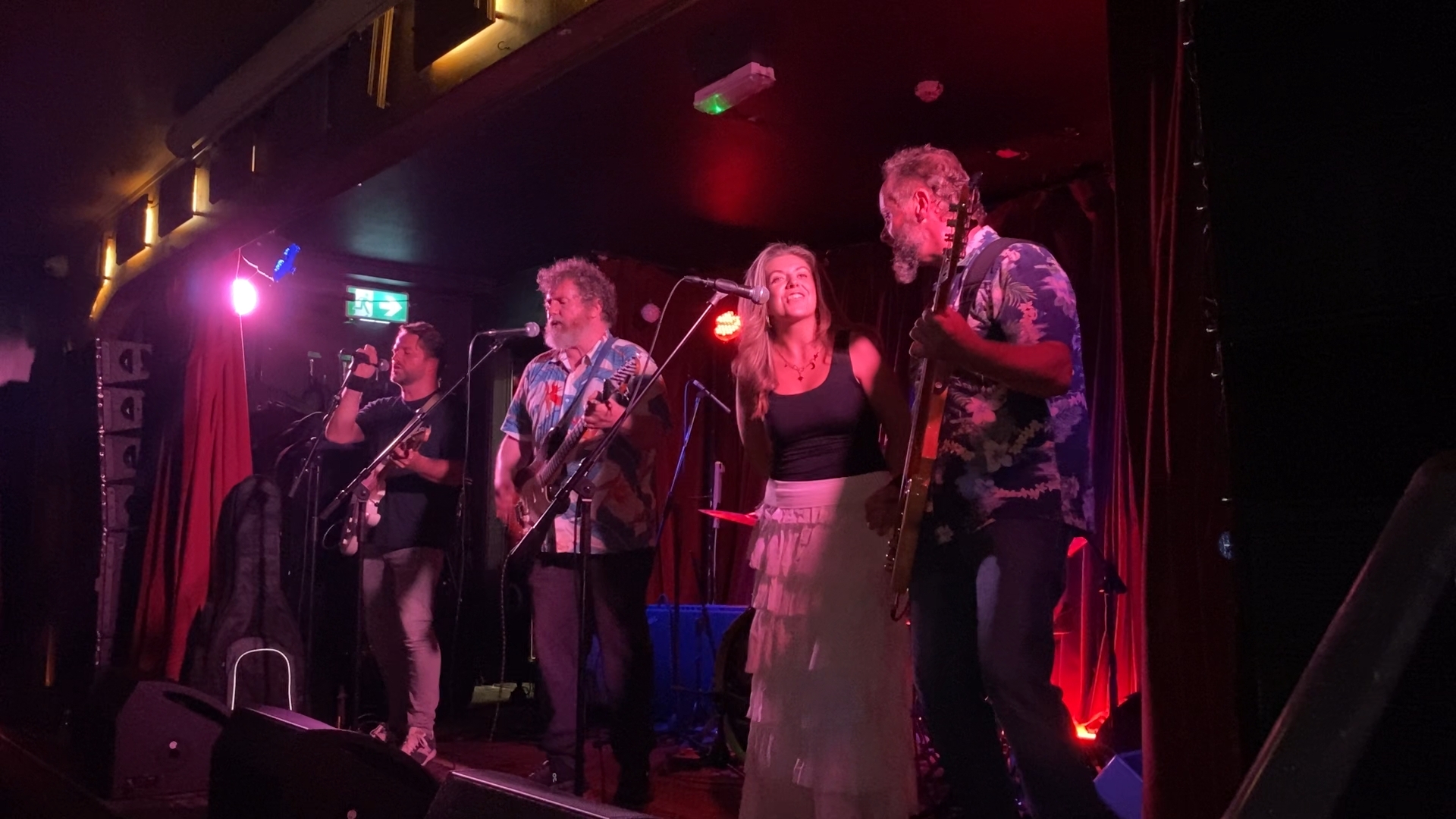
Frontman Derek Barrett is rarely still. He works the whole stage, involves the musicians around him, gets the audience singing and turns the performance into something shared rather than something simply being watched. At points the guitars move together in unison; at others Barrett is pulling a response from the crowd or moving across the stage to engage another member of the band.
Within a remarkably short time, people who had been standing watching were dancing.
That is particularly worth noting because familiar cover versions weren’t doing the work for them. The Arcadeans were getting people onto the floor with their own music, including single 99 Reasons, through performance, musicianship and connection with the room.
Guitarist Willie Magner was excellent, while the rhythm section with Niall O’Shea and Bill O’Brien kept everything firmly underneath the constant movement at the front. More than anything, the band looked as though they genuinely enjoyed playing together — and that kind of energy is difficult to fake.
Barrett eventually took the performance off the stage altogether, heading guitar-in-hand down into the crowd.
But there was another layer to The Arcadeans’ set.
James had played for many years with the band that eventually became The Arcadeans, and Barrett stopped during the set to speak warmly about him before the band played one of the songs they had performed together.
Those moments continually brought the night back to its purpose.
Finally came the headliners, The Grunts.
By this point Crane Lane was packed, with the normal late-night DJ crowd beginning to arrive on top of those who had come for the tribute. Five musicians filled a stage that suddenly seemed very small indeed.
The Grunts didn’t feel like a frontman backed by anonymous musicians. Liam O’Shea occupied the centre, with guitarist and bassist alongside him across the front of the stage, and both took lead vocals at points during the set.
The band were extraordinarily tight.
O’Shea himself is an understated presence until The Grunts start playing. Then the scale of his voice, the precision of his guitar work and the sheer force of the performance take over. His fast, controlled pick attack was fascinating to watch, while the musicians around him were equally assured.
It was also difficult to forget what O’Shea had already done before playing a note: organising a night involving multiple acts, James’s family, musicians from different periods of his life and all the logistics that go with putting a benefit event together.
Then he had to get onstage and perform for his friend.
Perhaps the most poignant guest of the evening was James’s daughter, Róisín Spillane, who joined The Grunts for several songs, including Zombie.
There was no need to manufacture emotion around that moment. Seeing James Spillane’s daughter standing onstage singing alongside musicians who had shared so much of her father’s life said enough.
And really, that was the story of the night.
James Spillane was a drummer, but judging by the number of musicians who came to Crane Lane, the bands who wanted to play for him, his family, the friendships that endured and the emotion with which people still spoke about him, he plainly occupied a much bigger space than the seat behind a drum kit.
The proceeds from the evening went to the Irish Lung Fibrosis Association.
More than a year after his death, James Spillane is clearly still deeply missed.
But for a few hours at Crane Lane, his friends did what musicians perhaps do better than most of us.
They played for him.
No Responses